
What Technology Do Travel Advisors Use?
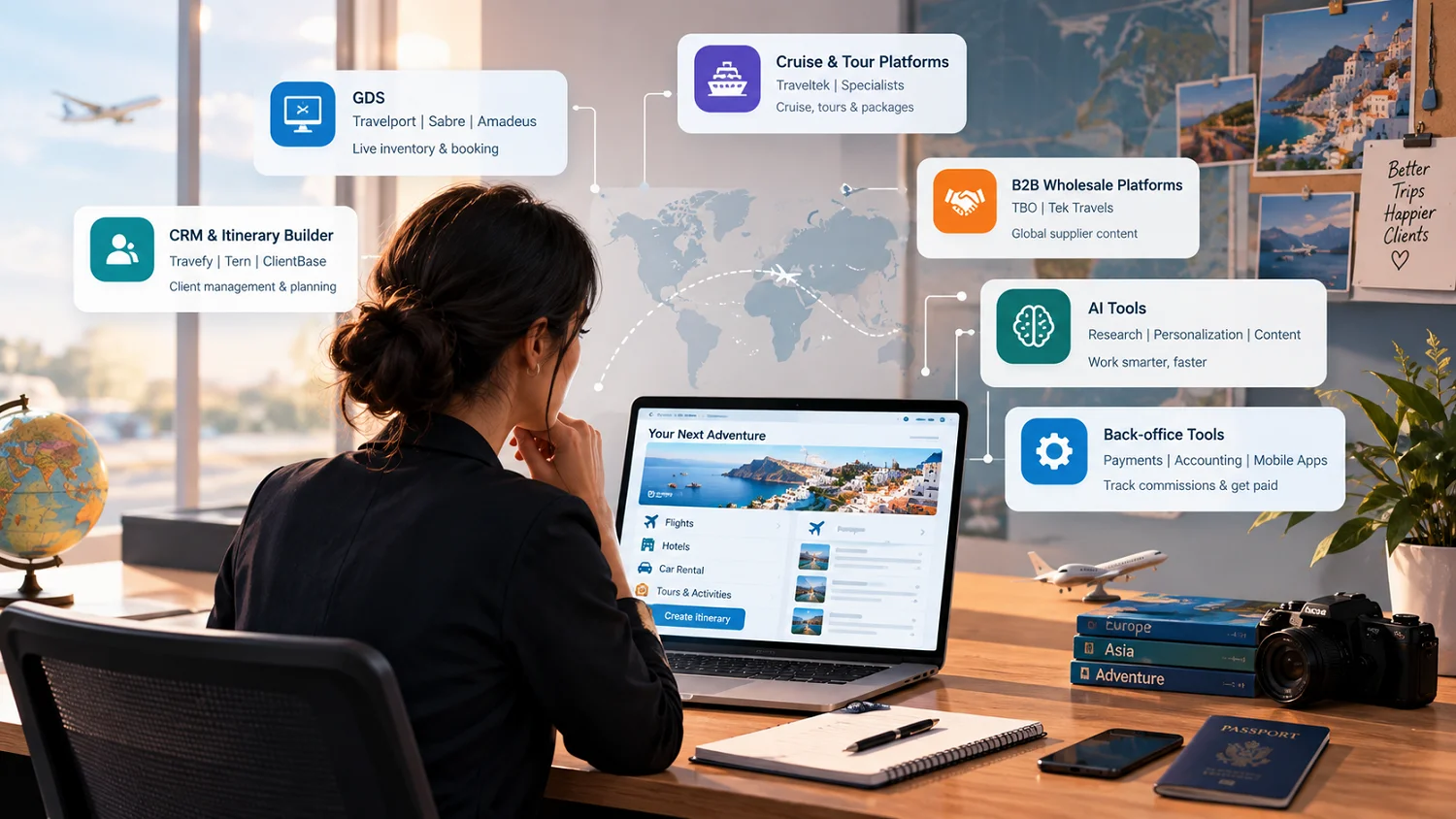
Travel advisors don’t run their business on a phone and a notebook anymore. Behind every itinerary is a stack of specialized software: a global distribution system (GDS) for searching live airline, hotel, and car inventory, a CRM and itinerary builder for managing clients, supplier platforms for cruises, tours, and wholesale content, and, increasingly, AI tools that speed up research and personalization.
Here’s what each piece actually does, how they fit together, and how to think about building a stack of your own.
The core technology stack
Global distribution systems (GDS): Travelport, Sabre, Amadeus
A GDS connects travel suppliers (airlines, hotels, car rental companies) with travel sellers (agencies, online travel agencies, and travel management companies) in real time. An advisor searches a route or a hotel, the GDS checks live availability and fares, and the booking gets confirmed and stored in a reservation record the advisor can manage later.
Travelport is one of the “big three” GDS platforms, alongside Sabre and Amadeus. It was built from three older systems (Apollo, Galileo, and Worldspan) and now runs on a unified platform called Travelport+, which layers AI-assisted search and newer NDC content (the newer airline retailing standard that’s gradually supplementing traditional GDS fares) on top of traditional GDS data.
A quick note on terminology before going further: most advisors who call themselves “independent” are independent contractors affiliated with a host agency, not a fully independent retail agency running its own accreditation. That distinction matters here because it’s the host agency, not the individual advisor, that typically holds the GDS contract. Most advisors don’t buy GDS access directly; it comes bundled through the host agency or consortium they’re affiliated with, using that organization’s credentials.
CRM and itinerary builders: Travefy, Tern, ClientBase
This is where client management actually happens: contact records, trip history, documents, proposals, and the polished itineraries clients see. Not long ago, many advisors were still building itineraries by hand in Word documents. Purpose-built tools have replaced much of that manual work.
In Host Agency Reviews’ 2026 advisor survey, Travefy was the clear leader for itinerary building, with Tern a distant second among advisors who prioritize workflow automation and commission tracking. ClientBase remains common, especially among larger or consortia-affiliated agencies with established back-office systems. Most of these platforms now bundle CRM, forms, invoicing, and a basic website builder into one subscription rather than requiring separate tools for each.
Cruise and tour booking platforms: Traveltek and specialists
Cruise and package travel run on their own technology, separate from standard GDS fares. Traveltek, a Glasgow-based company founded in the late 1990s, is one of the best-known names here. Its products, including iSell for dynamic packaging, CruiseConnect and AgentConnect for live cruise pricing, and iBos for back-office and CRM, connect to more than 30 major ocean and river cruise lines.
Traveltek’s CEO has stated that roughly a quarter to a third of UK cruise bookings move through its platform. That figure is self-reported rather than independently audited, but even as a directional claim it gives a sense of how specialized this corner of travel technology has become. Traveltek was acquired by Juniper Group, part of Constellation Software, in 2024, and has since added AI-assisted cruise search to its booking tools.
B2B wholesale platforms: Tek Travels (TBO) and similar
Below the GDS layer sits a tier of wholesale distribution platforms that give agents access to negotiated hotel, flight, and activity inventory, often useful for international and package travel where GDS content is thinner. Tek Travels, operating as TBO, is a large example: founded in 2006, it runs a global B2B travel distribution business serving agents in more than 100 countries.
Platforms like this matter most for advisors who build custom international packages rather than selling primarily through preferred GDS or cruise-line content.
AI tools
AI adoption among travel advisors has moved quickly. A survey of advisors affiliated with TRAVELSAVERS Canada, looking ahead to 2026, found generative AI usage had roughly doubled year over year, with about half of respondents now using it at least occasionally. Advisors report using it mainly for drafting itineraries, researching destinations, and writing marketing copy, not for client-facing chatbots; most advisors remain cautious about letting AI handle direct customer interactions.
Some booking platforms have started building AI directly into search. Traveltek, for example, added an “agentic” cruise search tool that turns a plain-language request, like a family-friendly Mediterranean cruise with good kids’ facilities, into ranked results in a few seconds.
Back-office tools: commission tracking and payments
Rounding out the stack are invoicing and payment tools, accounting integrations (QuickBooks is common), and mobile apps that let advisors work GDS queues from a phone, such as Travelport’s mobile agent app. These tools matter more than they might seem, because of how travel advisors actually get paid.
How travel advisors make money, and why tech matters to it
Most travel advisors earn through a mix of supplier commissions and, increasingly, client-paid planning fees. Rates vary by product and by the advisor’s sales volume with a given supplier: domestic airfare typically pays very little, around 0 to 5%, cruise commissions generally run 10 to 16% of the fare, and travel insurance is the outlier, often paying 15 to 40%.
Many cruise lines also run tiered programs that raise an agency’s rate once it crosses certain annual sales thresholds, so two advisors selling the same cruise line can earn different percentages. Advisors affiliated with a host agency receive a split of that commission rather than the full amount, since the host agency holds the IATA accreditation used to book and typically handles supplier invoicing. Payment timing varies by supplier, but it’s common for commission to land 30 to 90 days after the trip is complete, and sometimes later.
That payment lag, spread across dozens of suppliers with different rates and schedules, is exactly why CRM and back-office software has become essential rather than optional. Losing track of a single commission across that many moving parts is an easy way to lose real income, which is why commission tracking is now a standard feature in most advisor-focused CRM platforms rather than an afterthought.
Why use a travel advisor instead of booking it yourself?
All of this software exists to support a person, not replace one, and that’s worth spelling out. A 2026 study commissioned by Transat Distribution Canada and conducted by Ipsos, surveying more than 1,200 Canadian travelers, found that travelers increasingly value advisors for things software can’t easily replicate:
navigating complexity, troubleshooting when something goes wrong mid-trip, and access to rates or perks through consortia like Virtuoso that aren’t available to the public. If a flight gets canceled or a hotel loses a reservation, a good advisor is the one making calls on a traveler’s behalf, often while the traveler is still asleep in a different time zone.
Because travel advising is lightly regulated, with no license required in most places to call yourself an advisor, it’s worth knowing how to tell a credentialed advisor from an unqualified one. The American Society of Travel Advisors runs a directory called VeriVacation that lists advisors who’ve earned its Verified Travel Advisor certification, a program with minimum experience and training requirements. It’s a useful starting point, though it only covers advisors who’ve opted into that specific certification, not every legitimate advisor in the industry.
Choosing a tech stack: a quick framework
What an advisor actually needs depends on where they are:
- New, host-affiliated advisor: GDS access usually comes bundled through the host agency. The first independent purchase is typically a CRM and itinerary tool like Travefy or Tern.
- Cruise-focused advisor: A specialist platform like Traveltek’s suite is worth the investment once cruise bookings become a meaningful share of revenue.
- International or package-heavy advisor: A wholesale B2B platform fills gaps that standard GDS content doesn’t cover well.
- Any advisor evaluating AI tools: Start with back-office tasks, like drafting and research, rather than client-facing chat, which is where most advisors currently draw the line.
Frequently asked questions
What are travel advisors?
Travel advisors, also called travel agents, are professionals who plan and book trips on behalf of clients, from flights and hotels to full custom itineraries. Most work as independent contractors affiliated with a host agency, which provides GDS access, supplier relationships, and accreditation.
What is travel technology?
Travel technology is the software layer that connects suppliers, such as airlines, hotels, and cruise lines, with the people who sell and book travel. It includes GDS platforms, CRM and itinerary tools, booking engines, and increasingly, AI-powered search and personalization tools.
Which software is used in a travel agency?
Most agencies run some combination of a GDS (Travelport, Sabre, or Amadeus) for live booking, a CRM and itinerary platform (Travefy, Tern, or ClientBase) for client management, and category-specific tools for cruises or packages, such as Traveltek, or wholesale B2B inventory, such as Tek Travels/TBO.
Do independent advisors need to buy their own GDS license?
Usually not. Most independent advisors get GDS access through the host agency or consortium they join, rather than contracting with Travelport, Sabre, or Amadeus directly.
Is AI replacing travel advisors?
Not based on current evidence. Industry surveys show advisors adopting AI to work faster, mainly for research and drafting rather than client-facing conversations, while separate traveler research shows advisors remaining in demand as trip planning gets more complex. Those two trends running in parallel don’t prove AI is making advisors more necessary, but they do show AI adoption and advisor demand rising together rather than one replacing the other, at least so far.
