AI Agent Governance: What It Means and Why Enterprises Need It
AI agent governance is the set of policies, roles, and technical controls that decide what an autonomous AI agent is allowed to do, who is accountable for its actions, and how those actions are tracked. It covers identity, permissions, oversight, and audit trails for software that can take action on its own, not just software that answers a prompt.
Enterprises need this now because agent adoption has moved far ahead of agent control. Microsoft data shows most Fortune 500 companies are already running AI agents in some form, yet research from Gartner and Deloitte finds only a small share of organizations believe their governance is actually ready for that scale. That gap is where production failures, compliance exposure, and abandoned pilots come from.
What AI agent governance actually means
Traditional AI governance was built to control how people use AI tools: acceptable use policies, content filters, and data protection at the point of a prompt. It assumed a human reads an output and decides what to do with it.
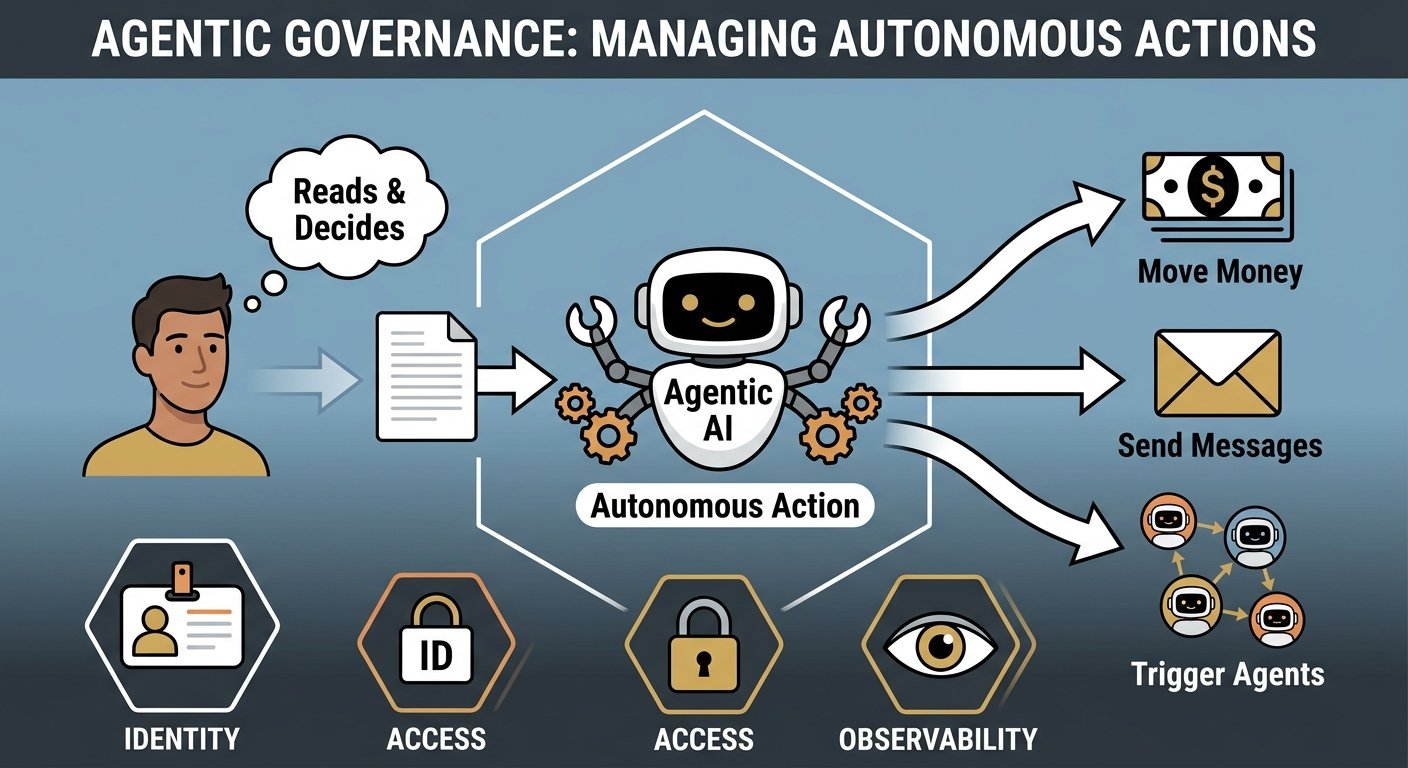
Agent governance is a different discipline because agents act. An agent can call APIs, move money, edit records, send messages, or trigger another agent, often across several systems in a single task. When an agent makes a mistake, it does not just produce a bad answer. It takes a bad action, and that action can be hard to undo.
This shift means governance now has to treat agents the way security teams treat employees or service accounts: as identities that need provisioning, permissions, monitoring, and offboarding. It also has to account for multi agent workflows, where one user request can expand into a chain of agent to agent calls, each one a point where something can go wrong or go unrecorded.
Why enterprises need it now
Three pressures are converging at once.
Scale is outrunning visibility. Gartner estimates that an average Fortune 500 enterprise could be running more than 150,000 AI agents by 2028. Lenovo research reports that more than 70 percent of current enterprise AI usage lacks proper oversight. Most organizations cannot yet answer basic questions like which agents exist, what systems they can touch, and who approved them.
Regulation is now agent specific, not just model specific. Singapore’s IMDA published a Model AI Governance Framework for Agentic AI in January 2026, the first major regulatory framework built specifically for autonomous agents. It requires each agent to carry a verifiable digital identity and an audit trail showing which agent acted under whose authorization. In the United States, NIST’s Center for AI Standards and Innovation launched an AI Agent Standards Initiative in February 2026, built around agent identity, security, and authorization. In the European Union, the AI Act’s transparency obligations and enforcement powers took effect on August 2, 2026, and apply broadly. Its stricter high risk obligations were delayed by a Digital Omnibus agreement, now set for December 2027 for standalone high-risk systems and August 2028 for high risk systems embedded in regulated products, so the deadline moved but the requirements did not disappear.
Boards and auditors are asking direct questions. AI governance has moved from a policy checkbox to a standing item in security reviews, procurement, and board risk discussions. Deloitte’s 2026 research found that only about one in five surveyed organizations has a mature governance model for agentic AI, which means most companies are exposed to exactly the kind of incident that draws regulatory and reputational attention.
Core components of an agent governance framework
| Component | What it covers |
|---|---|
| Identity and lifecycle | A registered identity for each agent, its role, its human owner, and a process for provisioning and retiring agents, the same way a company manages employee or service account identities |
| Access and permissions | Scoped, least privilege access to the specific systems and data each agent needs, instead of broad standing credentials |
| Observability and audit logging | A record of every action an agent takes and, where possible, the reasoning behind it, so an incident can be traced back to its cause |
| Policy and approval | A written policy on what agents may and may not do on their own, with a named owner for agent decisions and a defined sign off process for high impact use cases |
| Human oversight | Checkpoints where a person reviews or approves an agent’s action before it executes, scaled to the risk of that action |
| Risk tiering | Mapping each agent to a trust tier based on its autonomy and the sensitivity of what it can touch, so governance effort matches actual risk instead of being all or nothing |
Gartner analyst Shiva Varma has pointed to that last point as a common failure mode: enterprises often treat agent governance as binary, either fully locked down or fully trusted, when the more durable approach is tiered trust matched to what each agent is actually allowed to do.
Our recent Blog post: How to Reduce Your AI Coding Token Costs
Getting started
Most enterprises do not need to build a full framework before taking the first useful step. A practical starting point is an inventory: list every agent currently in production, what it can access, and who owns it. That single exercise usually surfaces the biggest gaps on its own, including agents nobody remembers approving.
From there, assign an owner for agent decisions, write a short policy on what agents can do without human sign-off, and put basic logging in place so every action can be traced. Governance built this way, as engineering practice rather than paperwork, is what lets enterprises scale agents without scaling their risk at the same pace.
