
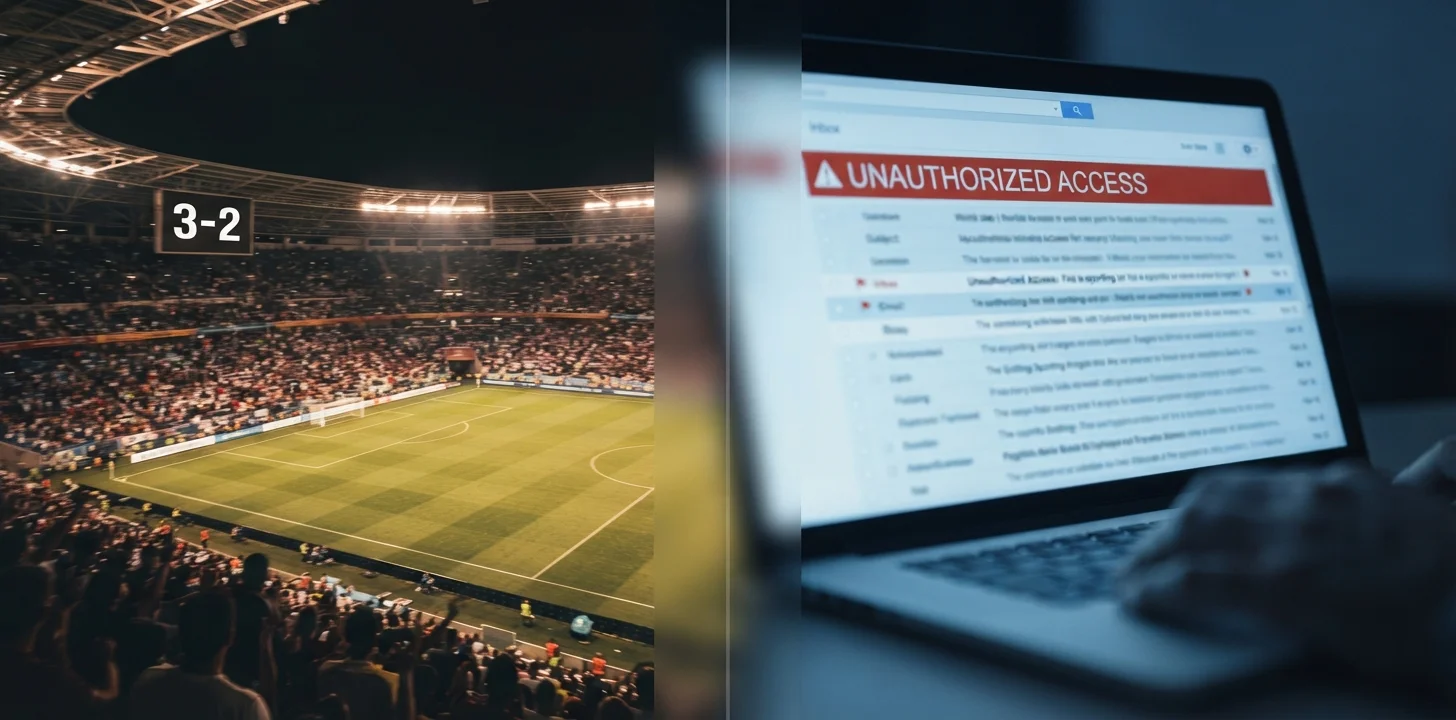
Argentina Football Emails Were Hacked Following Controversy Against Egypt
Argentina’s football federation confirmed a cyberattack this week, just days after one of the most controversial matches of the 2026 World Cup. The Argentine Football Association, known as AFA, said an unauthorized party accessed one of its institutional email accounts and used it to send messages accusing Argentina of stealing its win over Egypt.
It’s an odd, messy story. Not because the football part is confusing, that part is straightforward enough, but because a genuine cybersecurity incident got tangled up with a genuine officiating dispute within about 48 hours of the final whistle. Here’s what’s actually been confirmed, and what’s still just claimed.
What happened in the match
Egypt came into the Round of 16 clash looking like they might pull off the tournament’s biggest upset. They led Argentina 2-0 in Atlanta, and for a long stretch it looked like the defending champions were heading home early.
Then Argentina scored three times in roughly 13 minutes, starting in the 79th minute, before Enzo Fernandez put the game away in stoppage time. Final score: 3-2. A stunning comeback, depending on who you ask, or a result shaped by the referee, depending on who else you ask.
That second view has some specifics behind it. French referee François Letexier and his assistants took heavy criticism after VAR ruled out an Egyptian attacking sequence following a foul by Marawan Attia on Lisandro Martinez. Egypt also had penalty appeals waved away after a challenge by Julian Alvarez on Mohamed Salah. Two decisions, both going Argentina’s way, both arriving at moments that mattered.
Egypt’s manager, Hossam Hassan, didn’t hold back afterward, calling the result unjust and questioning the officiating. He went further too, suggesting commercial interests tied to Argentina and Lionel Messi had shaped the outcome, a claim that got plenty of attention on its own. Egypt’s federation followed up with a formal complaint to FIFA, asking for Letexier’s performance to be investigated.
FIFA said no. Chief refereeing officer Pierluigi Collina defended the officiating team, and Spain coach Luis de la Fuente publicly backed the key calls as correct. So as of now, the result stands, and FIFA isn’t budging on the bias claims. Whether that settles anything for Egyptian fans is a separate question.
Then the emails started
While that argument was still playing out in the press, journalists covering the tournament started receiving strange messages, sent from an actual AFA email account. Not a spoofed lookalike domain. The real thing.
One message reportedly read: “Argentina did not win. The victory was stolen through corrupt refereeing decisions.” Another, seen by The Athletic, opened with the line “the robbery will not go unnoticed” and went on to say that “security is an illusion, just like the integrity of that match.” The messages praised Egypt’s performance and reportedly threatened further disruption if there wasn’t, in their words, “justice.”
AFA moved fast to distance itself. In a statement, the federation said it had detected the possible sending of emails from one of its institutional accounts that were neither generated nor authorized by its team, and it asked journalists to disregard anything unusual coming from AFA addresses, especially messages with links or attachments.
That’s the confirmed part: AFA’s email system was accessed without authorization, and unapproved messages went out under its name. What’s less confirmed is who did it.
The attribution problem
Several reports point to a group signing off as “All Egyptian Cyber Warriors,” and some Argentine and Uruguayan outlets cite claims that an Egyptian hacker group took credit online, allegedly offering pieces of a stolen database for sale. One report also mentions the AFA Medios database, the system that handles media accreditation, as a possible entry point, with exposed data reportedly including email addresses, IP addresses, and passwords belonging to journalists and officials.
Worth being careful here, though. A signature on an email and a claim on a forum aren’t the same as a confirmed identity. No official body- not AFA, not FIFA, not Egypt’s football federation- has verified who actually carried this out. Egypt’s federation itself hasn’t been tied to the breach in any credible way; whoever sent these emails did so without any known connection to Egypt’s official football structure. Attaching a national label to an unconfirmed group is exactly the kind of shortcut that makes a messy story worse, so treat the “Egyptian hackers” framing as alleged, not settled.
AFA, for its part, told The Athletic by Friday that it considered the situation “resolved,” though the full scope of the breach hasn’t been made public.
Why this matters beyond one federation
Sports organizations aren’t usually thought of as high-value cybersecurity targets, at least not compared to banks or government systems. This incident is a reminder that during something like a World Cup, with global attention and raw national emotion both at a peak, that assumption doesn’t really hold. A federation’s press and accreditation systems touch a lot of people quickly, which makes them useful for exactly this kind of disruption.
I’d also flag the emotional layer here, because it’s easy to miss if you’re just skimming headlines. The dispute isn’t only about a missed call or a VAR review. It’s tangled up with national pride, accusations of corruption at FIFA’s biggest event, and now a cyberattack that used real journalists’ inboxes as the delivery method. That combination is going to keep this story alive longer than a typical officiating controversy would.
Conclusion
What’s confirmed: AFA’s email system was compromised, and unauthorized messages accusing Argentina of an unfair win were sent to journalists from a real institutional account. What’s alleged but unverified: that an Egyptian-linked hacker group is responsible, and that a broader database of journalist and official data was exposed and possibly put up for sale.
The football result itself isn’t in question, FIFA has rejected the bias claims, and the 3-2 score stands. The cybersecurity side is still under investigation, and until AFA or an independent party confirms more, the “who” behind this remains genuinely unclear. Worth checking back on this one as the investigation develops.
